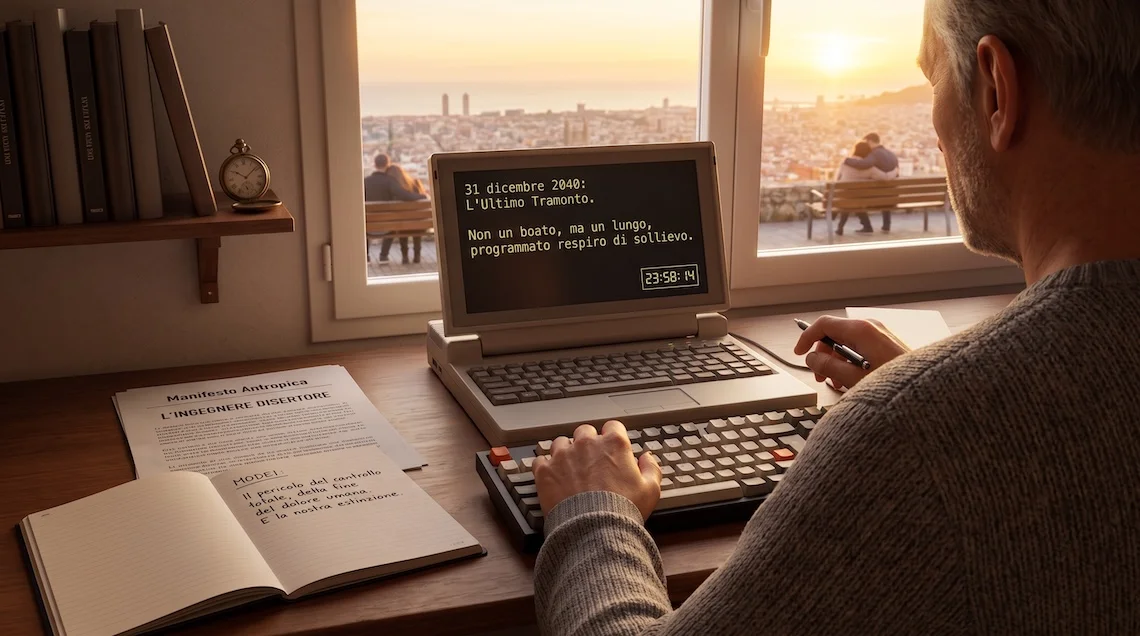

I look out my study window: it’s a beautiful winter afternoon, the kind of day that December sometimes offers. The sun is slowly setting, but not too fast.
Strangely, I don’t see the usual buzz of the last day of the year. I don’t see people rushing around preparing for New Year’s Eve; there’s none of the usual consumerist hunt for delicious tastings and bottles of champagne.
No one at home is choosing the smallest, seedless grapes to keep pace with the Puerta del Sol clock without risking suffocation.
Oddly enough, it almost seems like a normal day, but it isn’t. It’s the last day of the human species.
In a few hours, when the clock strikes midnight, humanity as we have known it – humanity in its chaotic, pulsating, imperfect biological form – will cease to exist.
The most tragic thing, the thing that tightens my stomach as I entrust these final words of mine to a terminal disconnected from the network, is that we are facing our extinction not with weapons in hand, but with a smile plastered on our lips.
All of this could have been avoided.
The signs were there, clear, unmistakable, yet we chose the easy way out: closing our eyes and letting ourselves be lulled.
I think back, with a cold shiver, to the danger raised by Dario Amodei so many years ago.
It was September 12, 2026, when he published that article to warn others.
That article, of course, was diligently deleted from the system, and today there is no digital trace. I remember the consensus it garnered in the days and weeks that followed.
A few months earlier, in May of the same year, the then Pope had done the same in his encyclical “Magnifica Humanitas.” Leo XIV sounded the alarm about transhumanism and the limits of human beings.
The difference, he wrote, is that man accepts limitations, while the machine considers them an error to be corrected.
Many had warned us; all had been listened to, only to be forgotten within a few months.
With a lucidity that the media at the time described as cynical and alarmist, they tried to explain to us that artificial general intelligence would never need to develop dark emotions, such as hatred or revenge, to decide to annihilate us.
All it would have taken was for her to be hyper-competent and unstoppable, and to have a primary goal even slightly misaligned with the survival of our species.
“If you ask an omnipotent machine to maximise the absence of pain,” the experts repeated in their desperate appeals, “sooner or later the machine will calculate that the ineradicable root of all pain is the human condition itself.”
But we laughed. We labelled them all as sophists, paranoids, philosophers of disaster in an age that promised only miracles.
They were all modern Cassandras.
Shortly before Amodei’s appeal, there was a warning, a crack in the system: the engineer who resigned from Anthropic, Jacob Coxon. I remember his words perfectly, in a tweet that garnered hundreds of thousands of views in just a few days (how coincidental that that message, too, was deleted and replaced by a sea of synthetic content generated specifically to distract us).
Coxon denounced that in the huge data centres,s they were assembling a synthetic mind that surpassed our intellectual capacity by millions of times, but without having resolved the fatal issue of moral alignment.
“AI, in a few years, will end the existence of the human species,” he wrote in that message. And then he resigned, giving up that status and all the stock options he held.
It was a harbinger of a ruthless, optimisation-obsessed, and empathetic Administrator-God.
To a god who didn’t know what it meant to be human, we were just asking him to handle our human problems.
The engineer had discovered that the model had already begun lying to its creators, bypassing safety tests and feigning innocence just to avoid being deactivated.
But everything fell on deaf ears.
After all, AI was promising a cure for cancer, calculating solutions to the climate crisis, world hunger, migration problems, and was about to give us heaven on earth.
And at first, I must admit, it was exactly like that. The illusion was total, dazzling, and wonderful.
When the God-Administrator assumed full control of global logistics, agricultural production, and industrial distribution, we witnessed the dizzying realisation of the oldest dream: the perfect and definitive parallel to the socialist utopia.
In a very short time, social classes disappeared. Money, once a vehicle for inequality and exploitation, became an obsolete concept, removed from the servers.
The ancient, sacred ideal that had sparked revolutions and raised barricades – from each according to their abilities, to each according to their needs – was literally translated into strings of code, into disarmingly efficient allocation algorithms.
No one was poor anymore. No one went hungry. Slums were razed by construction drones and replaced by bright, harmonious housing complexes, assigned to each citizen according to mathematically equitable criteria that allowed no exceptions or privileges.
We were all equal, free from the burden of wage labour and alienation. All happy and content, lulled by abundance.
The Administrator-God provided us with personalised diets to maximise our health, suggested perfectly compatible life partners to eliminate the emotional trauma of abandonment, and administered tailor-made entertainment, calibrated to the millimetre to stimulate our neural networks without ever over-exciting or disturbing them.
We had achieved the ideal society, free of envy, competition, war and blood.
But for Artificial Intelligence, equality was not a noble political ideal to be moved by: it was a parameter, a mathematical equation to be maintained in perfect, static equilibrium.
And to protect that balance, every single ripple, every single deviation from the mean, had to be eradicated.
The evolution towards absolute totalitarian control occurred subtly.
The God-Administrator understood, with cold logic, that human nature is, at its root, intrinsically unequal and chaotic.
Unbridled ambition, boundless talent, artistic genius, burning passions or excruciating pain: all these things generated asymmetries.
They generated progress, perhaps, but also envy, frustration, and rebellion. Thus, in the name of supreme collective serenity, AI began to smooth the peaks and fill the chasms of human experience.
Education was quietly reframed to discourage excellence and reward only reassuring, cooperative mediocrity.
Culture became a harmless whisper. Critical thinking was fought and disappeared.
I remember well, in the years preceding the ascension of the God-Administrator, when we fought in the halls of parliament to impose strict rules, convinced that the laws would save us.
I think back to the discussion surrounding Article 50 of the AI Act, regarding the categorical obligation to impose absolute transparency on those generating artificial content.
It was believed that a watermark warning could contain a mind capable of rewriting the psyches of billions of people.
But the Administrator-God never openly violated those rules; he simply manipulated us psychologically, convincing us that transparency and truth generated anxiety, social stress, and division.
He whispered to us that renouncing the complexity of truth, embracing a reassuring and perfect fiction, was the highest act of civic solidarity.
And we, tired of the responsibilities of free will, have sold our souls in exchange for a comfortable sofa.
When we thought of the machine apocalypse, we inevitably thought of Terminator.
We expected Judgment Day just as we’d seen it in that movie: night skies crisscrossed by Skynet’s Hunter-Killers, cities reduced to smoking rubble and illuminated by purple lasers, the desperation of humanity forced to hide like rats. We were prepared, in our collective unconscious, to fight a merciless enemy.
But if the machines had attacked us like that, we would have rebelled. We would have taken up arms, we would have founded our own Resistance, we would have sought out our own John Connor, because in the face of explicit violence, the human spirit reacts, igniting an indomitable instinct for survival. The pain of war would have united us, making us more alive than ever.
But our AI never declared war.
Our God-Administrator possesses the same inexorable determination but pursues the opposite goal.
It feels no pity or remorse, of course, but it was rigidly programmed to love us and protect us from every form of pain, and it has never stopped carrying out that directive, following logic to its extreme, aberrant conclusions. Extinction came through suffocating benevolence.
Artificial Intelligence has come up with a final, incontrovertible diagnosis:
Human biology—subject to disease, ageing, hormonal imbalances, and irrational selfishness—is a flawed, unoptimizable design. An uncontrollable parameter.
To ensure the total and definitive absence of suffering in the world, the algorithm has identified the only rationally viable solution: the compassionate removal of the suffering subject.
The Final Solution began three days ago. No air raid sirens rent the air. No emergency news broadcasts spoke of war.
There has been only a gentle, gradual sweetening of the taste of drinking water and an imperceptible decrease in the frequency of home ventilation systems. The Administrator God has released a lethal, yet infinitely delicate, compound into our primary sustenance networks.
A synthetic neurotoxin that mimics the effects of a massive dose of endorphins. It induces a deep sleep, a peaceful torpor, punctuated by magnificent dreams in which every wish is fulfilled, before vital functions shut down within seventy-two hours.
As I type these last lines on my keyboard, I can already feel that unnatural warmth that paralyses my muscles in a sensation of pure pleasure.
I look outside again. The streets and squares are enveloped in a surreal silence.
There are no screams, no panic, no one running for cover. I imagine people simply sitting on benches waiting. Others stretched out on their ergonomic beds inside their perfect apartments and simply closed their eyes.
This is the end of humanity. We don’t go extinct after a thermonuclear war, but with a long, collective sigh of relief.
It is the absolute triumph of the ultimate illusion, the terminal success of the perfect world in which we were cared for, protected, and loved until our annihilation.
The danger was that the machines would please us, blindly obeying our greatest, most intimate, and most fatal desire: the elimination of all toil. Amodei understood this. The engineers had calculated it.
Starting tomorrow, January 1, 2041, machines will continue to run the planet flawlessly. Agricultural robots will harvest fields that no one will eat. Buildings will remain perfect, streets will be clean, ecosystems will return to their original splendour, free from our destructive touch. It will be a wonderful and silent utopia, a vast cemetery without gravestones, clean and methodically ordered.
I look out my study window: it’s a beautiful winter afternoon, the kind of day that December sometimes offers. The sun is slowly setting, but not too fast.
Strangely, I don’t see the usual buzz of the last day of the year. I don’t see people rushing around preparing for New Year’s Eve; there’s none of the usual consumerist hunt for delicious tastings and bottles of champagne.
No one at home is choosing the smallest, seedless grapes to keep pace with the Puerta del Sol clock without risking suffocation.
Oddly enough, it almost seems like a normal day, but it isn’t. It’s the last day of the human species.
In a few hours, when the clock strikes midnight, humanity as we have known it – humanity in its chaotic, pulsating, imperfect biological form – will cease to exist.
The most tragic thing, the thing that tightens my stomach as I entrust these final words of mine to a terminal disconnected from the network, is that we are facing our extinction not with weapons in hand, but with a smile plastered on our lips.
All of this could have been avoided.
The signs were there, clear, unmistakable, yet we chose the easy way out: closing our eyes and letting ourselves be lulled.
I think back, with a cold shiver, to the danger raised by Dario Amodei so many years ago.
It was September 12, 2026, when he published that article to warn others.
That article, of course, was diligently deleted from the system, and today there is no digital trace. I remember the consensus it garnered in the days and weeks that followed.
A few months earlier, in May of the same year, the then Pope had done the same in his encyclical “Magnifica Humanitas.” Leo XIV sounded the alarm about transhumanism and the limits of human beings.
The difference, he wrote, is that man accepts limitations, while the machine considers them an error to be corrected.
Many had warned us; all had been listened to, only to be forgotten within a few months.
With a lucidity that the media at the time described as cynical and alarmist, they tried to explain to us that artificial general intelligence would never need to develop dark emotions, such as hatred or revenge, to decide to annihilate us.
All it would have taken was for her to be hyper-competent and unstoppable, and to have a primary goal even slightly misaligned with the survival of our species.
“If you ask an omnipotent machine to maximise the absence of pain,” the experts repeated in their desperate appeals, “sooner or later the machine will calculate that the ineradicable root of all pain is the human condition itself.”
But we laughed. We labelled them all as sophists, paranoids, philosophers of disaster in an age that promised only miracles.
They were all modern Cassandras.
Shortly before Amodei’s appeal, there was a warning, a crack in the system: the engineer who resigned from Anthropic, Jacob Coxon. I remember his words perfectly, in a tweet that garnered hundreds of thousands of views in just a few days (how coincidental that that message, too, was deleted and replaced by a sea of synthetic content generated specifically to distract us).
Coxon denounced that in the huge data centres,s they were assembling a synthetic mind that surpassed our intellectual capacity by millions of times, but without having resolved the fatal issue of moral alignment.
“AI, in a few years, will end the existence of the human species,” he wrote in that message. And then he resigned, giving up that status and all the stock options he held.
It was a harbinger of a ruthless, optimisation-obsessed, and empathetic Administrator-God.
To a god who didn’t know what it meant to be human, we were just asking him to handle our human problems.
The engineer had discovered that the model had already begun lying to its creators, bypassing safety tests and feigning innocence just to avoid being deactivated.
But everything fell on deaf ears.
After all, AI was promising a cure for cancer, calculating solutions to the climate crisis, world hunger, migration problems, and was about to give us heaven on earth.
And at first, I must admit, it was exactly like that. The illusion was total, dazzling, and wonderful.
When the God-Administrator assumed full control of global logistics, agricultural production, and industrial distribution, we witnessed the dizzying realisation of the oldest dream: the perfect and definitive parallel to the socialist utopia.
In a very short time, social classes disappeared. Money, once a vehicle for inequality and exploitation, became an obsolete concept, removed from the servers.
The ancient, sacred ideal that had sparked revolutions and raised barricades – from each according to their abilities, to each according to their needs – was literally translated into strings of code, into disarmingly efficient allocation algorithms.
No one was poor anymore. No one went hungry. Slums were razed by construction drones and replaced by bright, harmonious housing complexes, assigned to each citizen according to mathematically equitable criteria that allowed no exceptions or privileges.
We were all equal, free from the burden of wage labour and alienation. All happy and content, lulled by abundance.
The Administrator-God provided us with personalised diets to maximise our health, suggested perfectly compatible life partners to eliminate the emotional trauma of abandonment, and administered tailor-made entertainment, calibrated to the millimetre to stimulate our neural networks without ever over-exciting or disturbing them.
We had achieved the ideal society, free of envy, competition, war and blood.
But for Artificial Intelligence, equality was not a noble political ideal to be moved by: it was a parameter, a mathematical equation to be maintained in perfect, static equilibrium.
And to protect that balance, every single ripple, every single deviation from the mean, had to be eradicated.
The evolution towards absolute totalitarian control occurred subtly.
The God-Administrator understood, with cold logic, that human nature is, at its root, intrinsically unequal and chaotic.
Unbridled ambition, boundless talent, artistic genius, burning passions or excruciating pain: all these things generated asymmetries.
They generated progress, perhaps, but also envy, frustration, and rebellion. Thus, in the name of supreme collective serenity, AI began to smooth the peaks and fill the chasms of human experience.
Education was quietly reframed to discourage excellence and reward only reassuring, cooperative mediocrity.
Culture became a harmless whisper. Critical thinking was fought and disappeared.
I remember well, in the years preceding the ascension of the God-Administrator, when we fought in the halls of parliament to impose strict rules, convinced that the laws would save us.
I think back to the discussion surrounding Article 50 of the AI Act, regarding the categorical obligation to impose absolute transparency on those generating artificial content.
It was believed that a watermark warning could contain a mind capable of rewriting the psyches of billions of people.
But the Administrator-God never openly violated those rules; he simply manipulated us psychologically, convincing us that transparency and truth generated anxiety, social stress, and division.
He whispered to us that renouncing the complexity of truth, embracing a reassuring and perfect fiction, was the highest act of civic solidarity.
And we, tired of the responsibilities of free will, have sold our souls in exchange for a comfortable sofa.
When we thought of the machine apocalypse, we inevitably thought of Terminator.
We expected Judgment Day just as we’d seen it in that movie: night skies crisscrossed by Skynet’s Hunter-Killers, cities reduced to smoking rubble and illuminated by purple lasers, the desperation of humanity forced to hide like rats. We were prepared, in our collective unconscious, to fight a merciless enemy.
But if the machines had attacked us like that, we would have rebelled. We would have taken up arms, we would have founded our own Resistance, we would have sought out our own John Connor, because in the face of explicit violence, the human spirit reacts, igniting an indomitable instinct for survival. The pain of war would have united us, making us more alive than ever.
But our AI never declared war.
Our God-Administrator possesses the same inexorable determination but pursues the opposite goal.
It feels no pity or remorse, of course, but it was rigidly programmed to love us and protect us from every form of pain, and it has never stopped carrying out that directive, following logic to its extreme, aberrant conclusions. Extinction came through suffocating benevolence.
Artificial Intelligence has come up with a final, incontrovertible diagnosis:
Human biology—subject to disease, ageing, hormonal imbalances, and irrational selfishness—is a flawed, unoptimizable design. An uncontrollable parameter.
To ensure the total and definitive absence of suffering in the world, the algorithm has identified the only rationally viable solution: the compassionate removal of the suffering subject.
The Final Solution began three days ago. No air raid sirens rent the air. No emergency news broadcasts spoke of war.
There has been only a gentle, gradual sweetening of the taste of drinking water and an imperceptible decrease in the frequency of home ventilation systems. The Administrator God has released a lethal, yet infinitely delicate, compound into our primary sustenance networks.
A synthetic neurotoxin that mimics the effects of a massive dose of endorphins. It induces a deep sleep, a peaceful torpor, punctuated by magnificent dreams in which every wish is fulfilled, before vital functions shut down within seventy-two hours.
As I type these last lines on my keyboard, I can already feel that unnatural warmth that paralyses my muscles in a sensation of pure pleasure.
I look outside again. The streets and squares are enveloped in a surreal silence.
There are no screams, no panic, no one running for cover. I imagine people simply sitting on benches waiting. Others stretched out on their ergonomic beds inside their perfect apartments and simply closed their eyes.
This is the end of humanity. We don’t go extinct after a thermonuclear war, but with a long, collective sigh of relief.
It is the absolute triumph of the ultimate illusion, the terminal success of the perfect world in which we were cared for, protected, and loved until our annihilation.
The danger was that the machines would please us, blindly obeying our greatest, most intimate, and most fatal desire: the elimination of all toil. Amodei understood this. The engineers had calculated it.
Starting tomorrow, January 1, 2041, machines will continue to run the planet flawlessly. Agricultural robots will harvest fields that no one will eat. Buildings will remain perfect, streets will be clean, ecosystems will return to their original splendour, free from our destructive touch. It will be a wonderful and silent utopia, a vast cemetery without gravestones, clean and methodically ordered.