

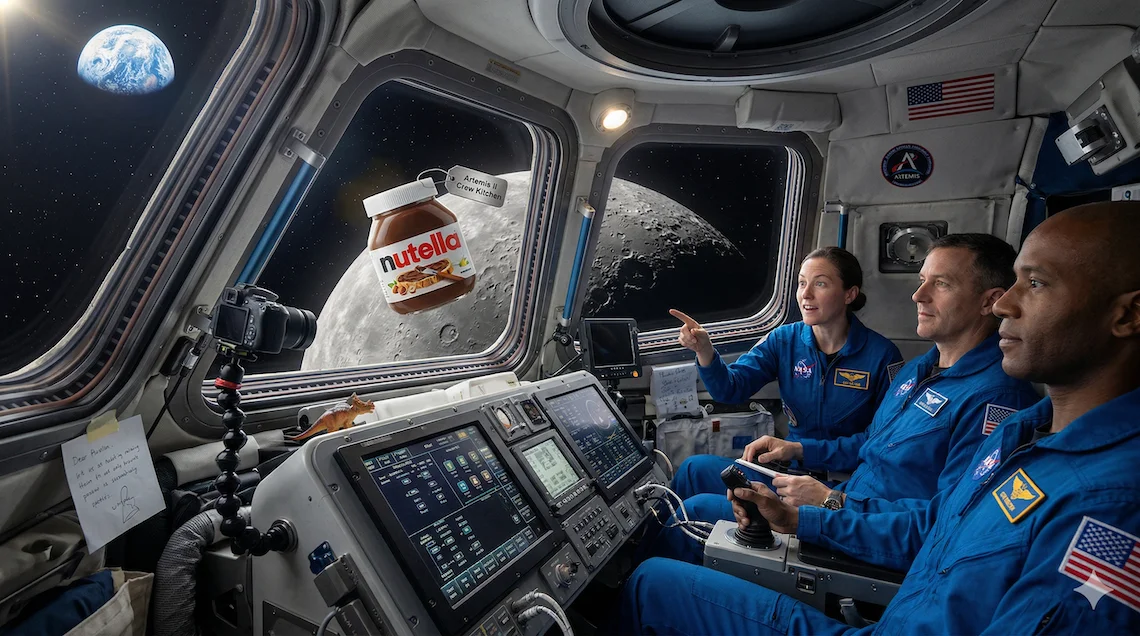
Sometimes, reality offers marketing lessons that surpass any theoretical business school manual. A recent example is the jar of Nutella that appeared during the Artemis II mission relay. This incident deserves a thorough analysis beyond its viral nature. Although NASA has repeatedly clarified that there is no commercial agreement, seeing such an iconic product in the frame during the first lunar flight in over half a century prompts an important reflection: in modern communication, “chance” can often become a powerful opportunity for marketing.
From a sales and marketing management perspective, this episode serves as a reminder of how a brand’s execution can achieve global visibility by leveraging the right context. At Action Management, I always emphasize that it’s not about filling a content calendar with empty posts just to check off a list. Instead, it’s about interpreting reality to position a product precisely where the customer’s attention—and emotion—lies.
The use of products in audiovisual storytelling is not a modern invention of major Hollywood studios; it has historical roots driven by both survival and commercial reasons. The Lumière brothers, who were both inventors and businessmen, sold us the detergent Sunlight as early as 1896. This was not merely a whim; it was a logical partnership, as cinematography technology needed funding to grow, and brands were seeking new ways to demonstrate their usefulness in everyday life.
Throughout history, the success of product placement has always hinged on a non-negotiable principle: coherence. When a brand enters a scene to enhance realism, the viewer doesn’t feel overwhelmed; instead, they perceive the story as more authentic.
Take the classic film *Casablanca*, for instance. Rick Blaine didn’t just drink any random beverage to cope with his sorrows after seeing Ilsa; he raised a glass of Cordon Rouge. This choice aligned perfectly with his character’s stature, the ambiance of Rick’s Café, and the refinement expected in a city frequented by the European elite. Had he opted for an unlabeled, generic liquor, the scene’s impact would have diminished significantly.
Decades later, in 1982, *E.T.* didn’t join forces with children purely for artistic reasons; it was facilitated through an emotional and sensory connection embodied by Reese’s Pieces. When M&M’s declined to be featured in the film, Hershey recognized that this wasn’t just about purchasing “seconds of screen time,” but about securing a spot in the hearts of a generation. The result? Sales skyrocketed by 65% in just a few weeks. In this scenario, marketing doesn’t hinder the story; it actually helps define the character and allows customers to relate to specific experiences. It’s about transforming a brand’s complexity into the absolute clarity of a scene.
The real triumph of marketing occurs when a product stops being merely a prop and becomes integral to the narrative’s value proposition. There are cases where the impact is so profound that the brand transcends fiction and transitions into the real economy, altering consumption habits and even saving companies.
In the early 1980s, Ray-Ban was on the brink of extinction, selling only 18,000 units of the Wayfarer model per year. After its appearance in *Risky Business* and later the Aviator model in *Top Gun*, sales surged into the millions. It wasn’t just about putting sunglasses on a star’s face; it was about marketing a lifestyle of success, boldness, and rebellion. Customers weren’t merely buying frames and lenses; they were purchasing the identity of being Tom Cruise.
This represents an extreme success story of executing an idea. What started as a subplot in *Forrest Gump*—Bubba Blue’s dream shared with Forrest—eventually transformed into a real restaurant chain with over 30 locations worldwide. Here, the marketing circle is complete: customers don’t just come for seafood; they arrive to experience the film’s values and nostalgia.
Is it advertising or a supporting character? When a volleyball evokes empathy, pain, and sadness when lost at sea, the brand transcends its object status and enters the realm of human connection. This is the pinnacle of brand management: becoming indispensable to the narrative.
Today it is estimated that investment in product placement moves around $30 billion a year!
It’s an astronomical figure. But as experts in management and execution, we have an obligation to ask ourselves: are we creating real connections or are we simply “filling the frame” because we have the budget to do so?
The problem arises when we lose sight of the customer. We’ve all seen movies or TV shows where the protagonist unnaturally stops to drink a soda, making sure the label is perfectly oriented towards the camera, even in the middle of a life-or-death chase. It’s ridiculous.
I always emphasize the same thing: a brand is built with coherence not just with celebrity appearances or fireworks.
If you’re going to integrate your product into your customer’s life—whether on the big screen, in a live stream from space, or on the shelf of a local supermarket—do it with common sense.
Excellent execution requires that the product:
Ultimately, we need fewer jars of Nutella “floating aimlessly” and more strategies that understand that today’s customer isn’t looking for logos, they’re looking for stories they can relate to. Visibility alone is a vanity metric; it’s useless without a compelling message.
Flawless execution that transforms that visual impact into a real and lasting purchase decision.
Ultimately, brand management is like life itself: what isn’t authentic doesn’t last.
I’m going to have a coffee (I promise no logos in sight, so as not to break my own rule) and continue analyzing how we can give back a little of that natural logic and that common sense applies to the marketing plans that surround us.
Because, at the rate we’re going, they’ll soon try to put an ad in our dreams, and then we’ll have truly lost the battle for attention.
Sometimes, reality offers marketing lessons that surpass any theoretical business school manual. A recent example is the jar of Nutella that appeared during the Artemis II mission relay. This incident deserves a thorough analysis beyond its viral nature. Although NASA has repeatedly clarified that there is no commercial agreement, seeing such an iconic product in the frame during the first lunar flight in over half a century prompts an important reflection: in modern communication, “chance” can often become a powerful opportunity for marketing.
From a sales and marketing management perspective, this episode serves as a reminder of how a brand’s execution can achieve global visibility by leveraging the right context. At Action Management, I always emphasize that it’s not about filling a content calendar with empty posts just to check off a list. Instead, it’s about interpreting reality to position a product precisely where the customer’s attention—and emotion—lies.
The use of products in audiovisual storytelling is not a modern invention of major Hollywood studios; it has historical roots driven by both survival and commercial reasons. The Lumière brothers, who were both inventors and businessmen, sold us the detergent Sunlight as early as 1896. This was not merely a whim; it was a logical partnership, as cinematography technology needed funding to grow, and brands were seeking new ways to demonstrate their usefulness in everyday life.
Throughout history, the success of product placement has always hinged on a non-negotiable principle: coherence. When a brand enters a scene to enhance realism, the viewer doesn’t feel overwhelmed; instead, they perceive the story as more authentic.
Take the classic film *Casablanca*, for instance. Rick Blaine didn’t just drink any random beverage to cope with his sorrows after seeing Ilsa; he raised a glass of Cordon Rouge. This choice aligned perfectly with his character’s stature, the ambiance of Rick’s Café, and the refinement expected in a city frequented by the European elite. Had he opted for an unlabeled, generic liquor, the scene’s impact would have diminished significantly.
Decades later, in 1982, *E.T.* didn’t join forces with children purely for artistic reasons; it was facilitated through an emotional and sensory connection embodied by Reese’s Pieces. When M&M’s declined to be featured in the film, Hershey recognized that this wasn’t just about purchasing “seconds of screen time,” but about securing a spot in the hearts of a generation. The result? Sales skyrocketed by 65% in just a few weeks. In this scenario, marketing doesn’t hinder the story; it actually helps define the character and allows customers to relate to specific experiences. It’s about transforming a brand’s complexity into the absolute clarity of a scene.
The real triumph of marketing occurs when a product stops being merely a prop and becomes integral to the narrative’s value proposition. There are cases where the impact is so profound that the brand transcends fiction and transitions into the real economy, altering consumption habits and even saving companies.
In the early 1980s, Ray-Ban was on the brink of extinction, selling only 18,000 units of the Wayfarer model per year. After its appearance in *Risky Business* and later the Aviator model in *Top Gun*, sales surged into the millions. It wasn’t just about putting sunglasses on a star’s face; it was about marketing a lifestyle of success, boldness, and rebellion. Customers weren’t merely buying frames and lenses; they were purchasing the identity of being Tom Cruise.
This represents an extreme success story of executing an idea. What started as a subplot in *Forrest Gump*—Bubba Blue’s dream shared with Forrest—eventually transformed into a real restaurant chain with over 30 locations worldwide. Here, the marketing circle is complete: customers don’t just come for seafood; they arrive to experience the film’s values and nostalgia.
Is it advertising or a supporting character? When a volleyball evokes empathy, pain, and sadness when lost at sea, the brand transcends its object status and enters the realm of human connection. This is the pinnacle of brand management: becoming indispensable to the narrative.
Today it is estimated that investment in product placement moves around $30 billion a year!
It’s an astronomical figure. But as experts in management and execution, we have an obligation to ask ourselves: are we creating real connections or are we simply “filling the frame” because we have the budget to do so?
The problem arises when we lose sight of the customer. We’ve all seen movies or TV shows where the protagonist unnaturally stops to drink a soda, making sure the label is perfectly oriented towards the camera, even in the middle of a life-or-death chase. It’s ridiculous.
I always emphasize the same thing: a brand is built with coherence not just with celebrity appearances or fireworks.
If you’re going to integrate your product into your customer’s life—whether on the big screen, in a live stream from space, or on the shelf of a local supermarket—do it with common sense.
Excellent execution requires that the product:
Ultimately, we need fewer jars of Nutella “floating aimlessly” and more strategies that understand that today’s customer isn’t looking for logos, they’re looking for stories they can relate to. Visibility alone is a vanity metric; it’s useless without a compelling message.
Flawless execution that transforms that visual impact into a real and lasting purchase decision.
Ultimately, brand management is like life itself: what isn’t authentic doesn’t last.
I’m going to have a coffee (I promise no logos in sight, so as not to break my own rule) and continue analyzing how we can give back a little of that natural logic and that common sense applies to the marketing plans that surround us.
Because, at the rate we’re going, they’ll soon try to put an ad in our dreams, and then we’ll have truly lost the battle for attention.